Losing a tooth changes more than your smile, and it is one of the most common reasons patients look into replacing missing teeth. It can affect how you chew, how you speak, and how confident you feel in daily life. Once the shock settles, a new question takes over. Should you choose a dental implant, a dental bridge, or a denture. Each tooth replacement option works in a different way, and each one suits a different kind of patient. This guide breaks down the real differences in plain language, so you can walk into your dental visit already knowing what questions to ask.
Dental implants are usually the best tooth replacement option for long term use, since they preserve the jawbone and feel closest to natural teeth. Dental bridges work well for replacing one or two missing teeth without surgery, while dentures remain the most practical choice for replacing multiple missing teeth or working with a lower budget. The right permanent replacement for missing teeth depends on your oral health, jawbone strength, number of missing teeth, lifestyle, and budget. At Sudanta Dental Care in Manikonda, Hyderabad, every patient receives a personalized evaluation before any recommendation is made.
What Is the Real Difference Between Dental Implants, Bridges and Dentures?
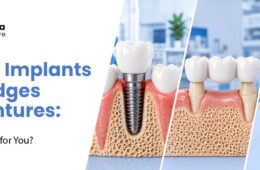
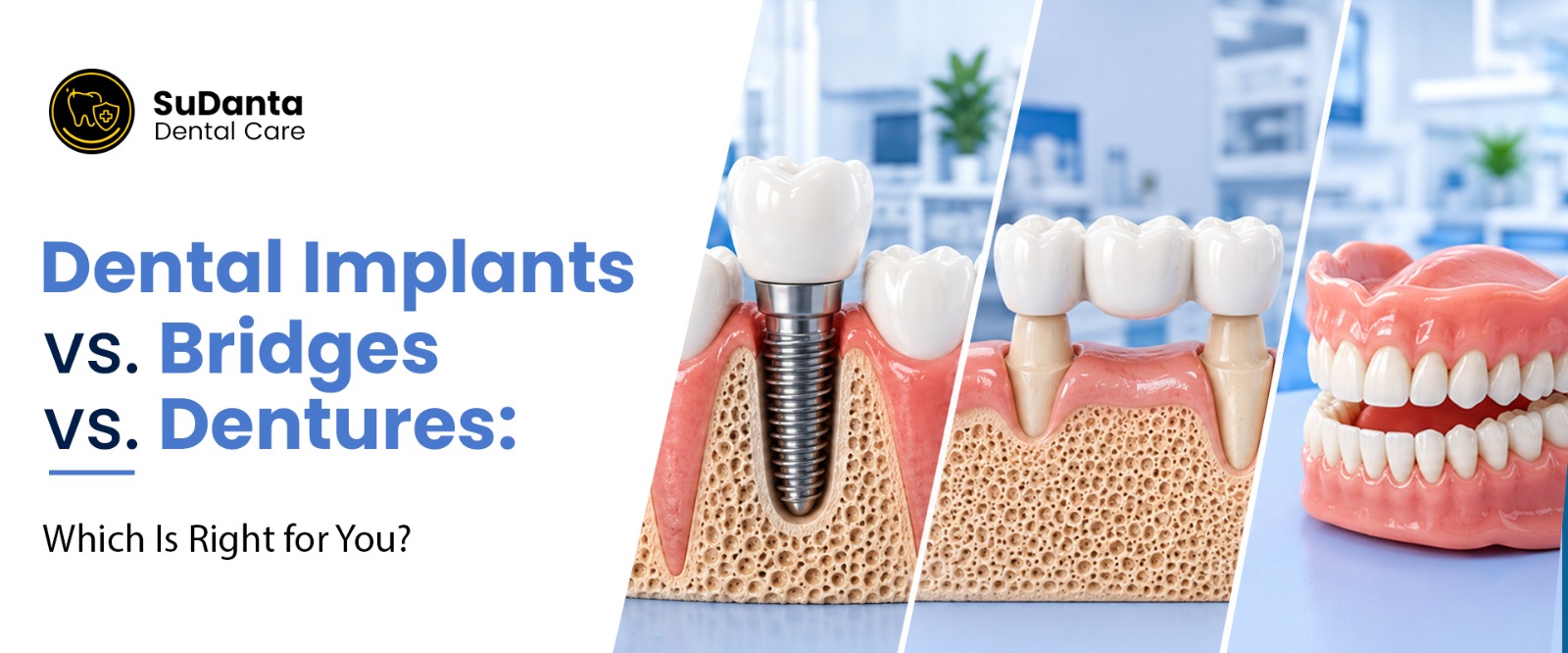
The three options solve the same problem in three different ways. A dental implant replaces the tooth root and the crown, so it stands on its own without touching the teeth next to it. A dental bridge replaces only the visible part of the tooth and depends on the strength of the abutment teeth on either side of the gap. A denture replaces one or many teeth at once and rests on the gum tissue rather than fusing into the bone. Dentures can be partial dentures, which replace a few teeth, or complete dentures, which replace an entire arch.
This difference in design explains almost everything else about these three false teeth options, including how long each dental prosthesis lasts, how stable it feels, and how much daily care it needs.
How Does Each Option Actually Replace a Missing Tooth?
An implant starts with a small titanium post placed into the jawbone. Over a few months, the bone grows around the post in a process called osseointegration. Once healed, a custom dental crown is attached on top. A bridge needs the two neighboring abutment teeth to be shaped down so crowns can be placed over them, with a false tooth called a pontic fused between the crowns. A denture uses a gum colored base with artificial teeth, held in place with clasps, suction, or an adhesive. Some patients later upgrade to an implant supported denture, which clips onto a small number of implants for extra stability.
Which Lasts Longer, Implants or Bridges, and Which Feels the Most Natural?
Dental implants generally last the longest of the three options, often lasting decades when cared for well, since the titanium post fuses directly with the jawbone. Bridges typically last around 10 to 15 years before the supporting teeth or the bridge itself need attention. Dentures usually need replacement or relining every 5 to 8 years because the gum and bone shape changes over time.
On feel and appearance, implants come closest to a natural tooth, since they stand alone in the bone and do not shift when you bite. A well made bridge also looks and feels quite natural, though patients sometimes notice a slight difference in sensation compared to a real tooth root. Dentures have improved a great deal in recent years, but many patients still notice some movement, especially with lower complete dentures, unless they are implant supported.
Longevity is not just about the material. It also depends on your oral hygiene, your bite pressure, and how often you visit your dentist for checkups. A well maintained bridge can outlast a poorly maintained implant, so daily care always plays a role. The type of crown also matters, since a full ceramic crown tends to hold up better under heavy chewing than a lower grade option.
How Much Do Implants, Bridges and Dentures Cost Over 10 Years?
Dentures are usually the most affordable tooth replacement option upfront, followed by bridges, with implants carrying the highest initial cost. However, cost should never be viewed only in upfront terms. An implant is often a one time investment, while dentures may need adjustments, relines, or full replacement every few years. Over a ten year period, the total cost gap between implants and dentures frequently narrows, since implants rarely need repeat procedures once they have healed properly.
It also helps to ask about hidden costs upfront. A fixed dental bridge may need replacement sooner if the supporting teeth develop decay underneath it, which adds a repeat cost down the line. A removable denture often needs relining within the first few years as your gums settle into their new shape. Your dentist can walk you through relative cost tiers based on the number of teeth involved, the material used, and whether any bone grafting is needed before an implant. Ask for a written cost breakdown so you can compare true long term value rather than just the number on day one.
Is a Dental Implant Painful, Safe, and Worth the Extra Cost?
Most patients describe implant surgery as far less painful than they expect. The area is numbed during the procedure, and mild soreness for a few days afterward is normal and manageable with standard care. Implants are considered safe for most healthy adults, but people with uncontrolled diabetes, active gum disease, or very low jawbone density may need bone grafting or a CBCT scan for detailed planning before treatment.
Access to affordable, timely dental care still remains a real challenge for many people in India, since close to 72.6 percent of the rural population continues to face limited access to oral health services, according to the National Oral Health Programme. This makes early consultation with a qualified dentist or prosthodontist even more important before choosing any surgical option, and it is also why many patients ask if the extra cost of an implant is genuinely worth it. For most people missing a single tooth with a healthy jawbone, the long term durability and jawbone preservation make implants a strong value over time, even though the upfront cost is higher.
Which Option Is Best for Different Types of Patients?
There is no single best tooth replacement option for everyone. The right choice shifts based on your age, health background, habits, and how many teeth you have lost.
Young Adults, Seniors, Diabetic Patients and Smokers
Young adults with good bone density and general health are often excellent candidates for implants, since the treatment can last for decades. Seniors can also get implants successfully in many cases, though healing may take slightly longer and a full health review is important first. Diabetic patients need well controlled blood sugar before implant surgery, since poor control can slow healing and raise the risk of complications. Smokers face a higher risk of implant failure because smoking restricts blood flow to the gums, so many dentists recommend quitting or cutting back before and after surgery. Patients in any of these groups who are not ideal implant candidates right now can often start with a bridge or denture and revisit implants later.
One Missing Tooth, Multiple Missing Teeth or a Full Mouth Restoration
A single missing tooth with healthy teeth on both sides is often a good case for an implant, since it avoids altering the neighboring teeth, and this applies whether it is a missing front tooth replacement or a back tooth. If several teeth are missing in a row, a bridge can be a faster and slightly more affordable fixed solution for replacing multiple missing teeth, though it needs strong abutment teeth to bear the load. Tooth loss tends to increase noticeably with age, and India’s National Oral Health Survey found that complete tooth loss becomes far more common in older adults than in adults in their late thirties and early forties, according to the National Oral Health Survey. When many teeth are missing, or when a full mouth rehabilitation is needed, dentures or implant supported dentures usually offer the most practical and comfortable path forward.
Can You Eat Normally, and How Long Does Recovery Take?
Chewing efficiency differs across all three options. Implants offer close to natural chewing efficiency, since they are anchored in bone like a real tooth root. Bridges also support normal eating once fully set, though very hard or sticky foods should still be approached with some caution. Dentures take more adjustment, and most patients start with softer foods before slowly returning to a fuller diet as they get used to the fit.
| Treatment | Typical Healing Time | Return to Normal Eating |
| Dental Implant | 2 to 6 months for full fusion | Gradual, full comfort after healing |
| Dental Bridge | 1 to 2 weeks | Within a couple of weeks |
| Denture | A few weeks of adjustment | Gradual, softer foods first |
What Does the Full Treatment Journey Look Like?
The general journey looks similar across all three options, though the steps and timeline vary. It typically begins with a consultation and oral exam, followed by an X-ray or CBCT scan to check bone health. Next comes treatment planning, where your dentist maps out the exact approach for your case. The treatment itself follows, whether that is implant placement surgery, bridge preparation, or denture fitting. A healing or adjustment period comes after, and the process ends with a final review visit to confirm everything fits and functions well.
How Do You Take Care of Each Type of Tooth Replacement?
An implant is cared for exactly like a natural tooth, with regular brushing, flossing, and dental checkups. A bridge needs extra attention under the pontic, often with a floss threader or interdental brush, since food can collect in that space. A denture needs to be removed and cleaned daily, soaked overnight in most cases, and checked periodically for fit as your gums change shape.
Skipping these care steps is one of the most common reasons any of these three options fail early. A five minute daily routine protects your investment far more than any material choice does. Regular dental checkups matter just as much as home care, roughly every six months for implants and bridges, and more often in the first year for new denture wearers as the fit settles.
Common Myths About Implants, Bridges and Dentures That You Should Ignore
Myth: implants always hurt. Fact: most patients report only mild, short term soreness that standard care manages well. Myth: dentures always fall out. Fact: a properly fitted denture, especially an implant supported denture, stays stable through normal eating and speaking. Myth: bridges ruin your teeth. Fact: a well placed bridge, cared for properly, protects the surrounding teeth for many years, though it does require reshaping the abutment teeth. Myth: older adults cannot get implants. Fact: age alone is rarely a barrier, and many seniors get implants successfully once their overall health is reviewed.
How Do You Decide Which Option Is Right for You?
There is no single best tooth replacement option for everyone. The right choice depends on how many teeth you are missing, the strength of your jawbone, your budget, your age, and how much surgery you are comfortable with. If a tooth is damaged but not fully lost, root canal treatment may save it and avoid replacement altogether, so it is worth ruling that out first. Many patients then start with a bridge or a denture and move to implants later once their situation allows it, and that is a perfectly reasonable path.
| If you… | Best Option to Consider |
| Lost one tooth with healthy neighbors | Dental implant |
| Lost two or three teeth in a row | Dental bridge |
| Lost many teeth or need full mouth restoration | Denture or implant supported denture |
| Want the longest possible lifespan | Dental implant |
| Have the lowest budget right now | Denture |
| Want to avoid surgery completely | Bridge or denture |
A Quick Self-Check Before Your Dental Visit
Ask yourself these questions before your appointment. Do you want a fixed option, or are you comfortable removing your teeth daily. Do you have one gap, or several. Is your jawbone healthy, or has it been a long time since you lost the tooth. What does your budget comfortably allow for right now versus over the next ten years. Bring these answers to your consultation and the conversation becomes far more useful.
Comparison Table: Implants vs Bridges vs Dentures
| Factor | Dental Implants | Dental Bridges | Dentures |
| Durability | Decades with care | 10 to 15 years | 5 to 8 years |
| Surgery Required | Yes | No | No |
| Impact on Neighboring Teeth | None | Requires reshaping | None |
| Bone Health | Preserves jawbone | Does not prevent bone loss | Does not prevent bone loss |
| Daily Comfort | Feels like a natural tooth | Fixed, stable | Removable, may shift |
| Relative Cost | Highest upfront | Moderate | Most affordable upfront |
Pros and Cons of Each Option
Dental Implants
Pros
- Feel and function like natural teeth
- Preserve jawbone density through osseointegration
- Can last decades with proper care
- Do not affect neighboring teeth
Cons
- Higher upfront cost than bridges or dentures
- Requires surgery and a healing period of two to six months
- May need a bone graft if jawbone density is low
Dental Bridges
Pros
- Fixed, non-removable solution
- Faster treatment than implants, often ready within a couple of weeks
- Lower upfront cost than implants
- Good option for replacing multiple missing teeth in a row
Cons
- Requires reshaping healthy abutment teeth
- Does not stop bone loss under the missing tooth gap
- Typically needs replacement every 10 to 15 years
Dentures
Pros
- Most budget friendly upfront
- No surgery required
- Suitable for replacing several or all missing teeth at once
Cons
- Can feel less stable than fixed options
- Needs daily removal and cleaning
- May require relining or adjustment as gums change shape
Frequently Asked Questions
Q: Can I switch from dentures to implants later?
A: Yes. Many patients start with dentures or a bridge and move to implants once their budget, health, or bone density allows it. Your dentist can guide you on timing and whether any bone grafting is needed before the switch.
Q: Do bridges damage the teeth next to them?
A: The abutment teeth need to be reshaped to hold the crowns, which does remove some healthy enamel. With good oral hygiene and regular checkups, these teeth can still function well for many years.
Q: How long does the implant healing process really take?
A: Healing usually takes two to six months, since the bone needs time to fuse around the implant post. The exact timeline depends on your bone health, the number of implants, and whether any grafting was needed.
Q: Will insurance cover any of these options?
A: Coverage varies widely by provider and plan, and dentures or bridges are sometimes covered more easily than implants. Ask your dentist for a detailed treatment estimate so you can check it against your specific policy.
Q: Are dental implants better than dentures?
A: Implants are usually better for long term durability, jawbone health, and natural feel, but dentures remain a practical choice when several teeth are missing or surgery is not an option. The better choice depends on your bone health, budget, and how many teeth need replacing.
Q: Can a dental bridge replace two missing teeth at once?
A: Yes, a single bridge can replace two or sometimes three teeth in a row, as long as the abutment teeth on either end are strong enough to support the extra load. Your dentist will check bone and gum health around those anchor teeth before confirming this is a safe option.
Q: How soon should you replace a missing tooth?
A: It is best to replace a missing tooth within a few months, since nearby teeth can start shifting and the jawbone can begin to lose density fairly quickly. Waiting longer often means more bone loss and a more complex treatment later on.
Q: Which option feels the most like natural teeth?
A: Dental implants come closest to natural teeth, since they anchor in the jawbone and function like a real tooth root. A well fitted bridge is a close second, while dentures generally feel the most different, especially before you adjust to wearing them.
How Sudanta Dental Care Approaches Tooth Replacement
At Sudanta Dental Care in Manikonda, Hyderabad, every tooth replacement plan starts with a proper evaluation, not a fixed recommendation. The team looks at your jawbone strength, the number of missing teeth, your budget, and your daily lifestyle before suggesting implants, bridges, or dentures. The goal is a solution that fits your mouth and your life, not a one size fits all package. Patients get a clear, honest breakdown of their options along with realistic timelines, so there are no surprises along the way.
Ready to Find the Right Option for Your Smile?
Book a consultation with Sudanta Dental Care in Manikonda, Hyderabad to get a personal assessment of your teeth, gums, and jawbone, and walk away with a clear treatment plan built around you.