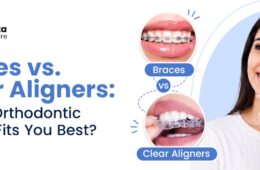
Crooked teeth, gaps, or a bite that feels off can all be corrected, but the path to get there usually comes down to two teeth straightening choices. Traditional braces or clear aligners, sometimes called invisible braces for their discreet look. Both straighten teeth effectively, yet they work in different ways and suit different people. The right pick depends less on which one is “better” overall and more on your specific teeth, your lifestyle, and how disciplined you can be with wearing an appliance every day.
Braces work well for almost any case, including complex bite problems, since they stay fixed on your teeth and do not depend on your daily habits. Clear aligners suit mild to moderate misalignment and appeal to people who want a nearly invisible, removable option, but they only work if you wear them for the recommended hours each day. Sudanta Dental Care in Manikonda, Hyderabad evaluates your bite, the complexity of your case, and your lifestyle before recommending either option.
What Is the Real Difference Between Braces and Clear Aligners?
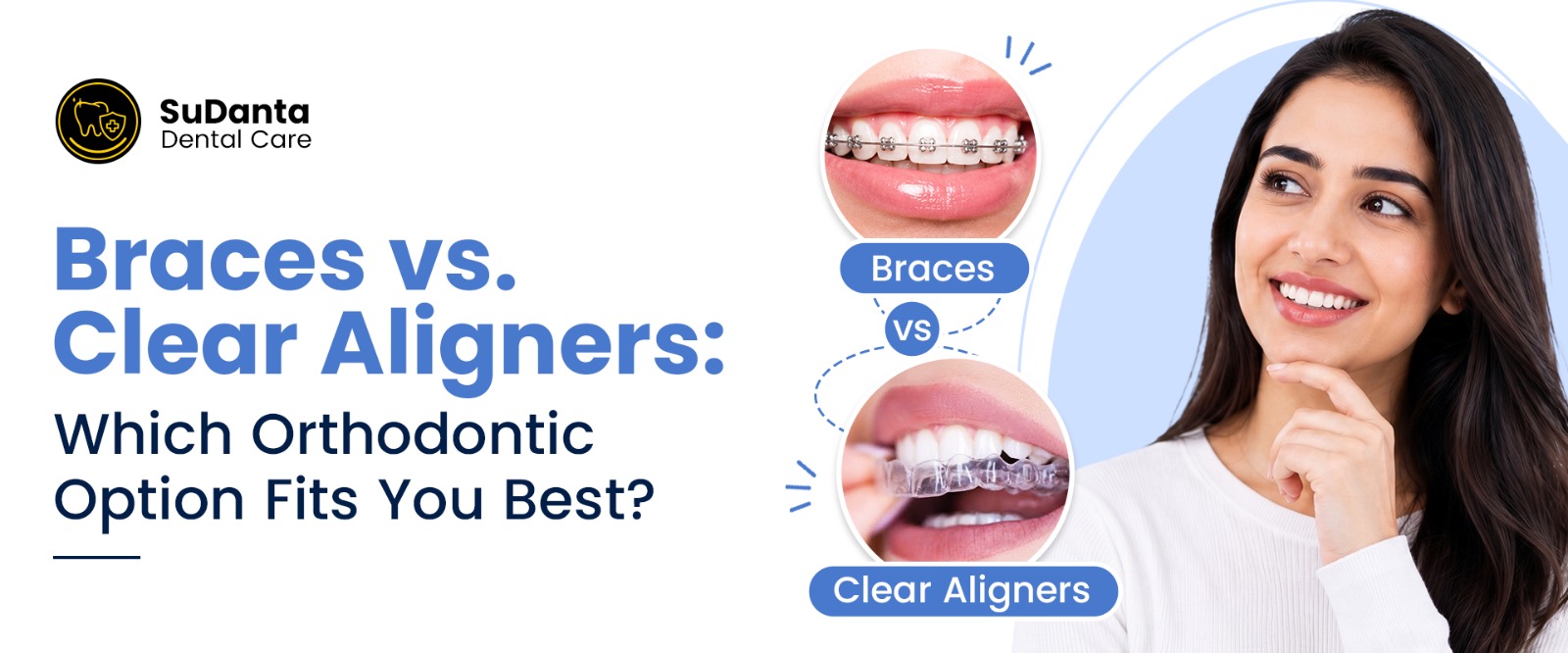
Braces use metal or ceramic brackets cemented to each tooth, connected by a wire that your dentist adjusts every few weeks to gradually shift teeth into place. Because they stay fixed to your teeth for the entire treatment, braces do not rely on you remembering to wear anything, which makes them consistent regardless of your daily routine.
Clear aligners are a series of custom made, clear plastic trays that you switch out every one to two weeks. Each tray in the series is slightly different, gradually guiding your teeth toward the final position. Unlike braces, aligners are removable, so you take them out to eat, brush, and floss, then put them back in for the rest of the day.
Both approaches rely on the same basic principle, gentle, sustained pressure that gradually moves teeth through the bone. The difference lies entirely in how that pressure gets applied, continuously through a fixed wire with braces, or through a sequence of slightly different trays with aligners. Neither method changes your jawbone structure or face shape, since both work only on the position of the teeth themselves.
Which Option Works Better for Your Specific Case?
Braces handle a wider range of problems, including significant crowding, large gaps, rotated teeth, and complex bite issues such as deep bites or crossbites. Because the wire applies continuous, precisely controlled force, braces can manage movements that aligners struggle with.
Clear aligners work best for mild to moderate misalignment, such as minor crowding, small gaps, or teeth that have shifted slightly over time. If your case involves more complex tooth movement or significant jaw related bite correction, your dentist may recommend braces instead, or a combination approach where aligners handle simpler cases and braces step in for anything more involved. In cases where damaged or worn teeth also need attention alongside alignment, restorative treatment may be planned together with orthodontic care.
How Will an Orthodontist Decide Whether Braces or Aligners Are Better for You?
An orthodontist does not choose based on preference alone. The evaluation usually starts with a bite assessment to check how your upper and lower teeth meet, along with measurements of crowding and spacing to see how much room your teeth actually need. Digital scans or X-rays show the position of your teeth and roots in more detail than a visual exam alone can provide.
Specific bite problems also guide the decision. An overbite, underbite, or crossbite may need the more controlled force that braces provide, especially in moderate to severe cases, while a straightforward spacing or crowding issue without major bite involvement often responds well to either option. Your orthodontist weighs all of these findings together, rather than picking an appliance based on appearance preferences alone.
Which Is More Comfortable and Easier to Live With Day to Day?
Aligners tend to win on daily comfort, since they are removable and free of the wires and brackets that can occasionally rub against your cheeks and lips. You can eat whatever you like by simply removing the trays first, and brushing and flossing stay just as easy as before treatment. Aligners are also more forgiving for playing instruments or contact sports, since they can be taken out when needed.
Braces, on the other hand, mean avoiding hard, sticky, and crunchy foods that could break a bracket or dislodge a wire. Cleaning around brackets and wires takes more effort and sometimes requires tools like floss threaders or interdental brushes to avoid plaque buildup. Braces are also more visible day to day, though ceramic or tooth colored options reduce this somewhat.
Do Braces Hurt More Than Clear Aligners?
Both options cause some discomfort, but the pattern differs. Braces tend to cause more soreness right after each adjustment visit, since tightening the wire applies a fresh round of pressure across all your teeth at once. This usually settles within a few days. Aligners cause a milder, shorter discomfort each time you switch to a new tray, typically lasting a day or two as your teeth adjust to the slightly different shape. Neither option should cause sharp or lasting pain, and persistent discomfort with either is worth mentioning to your dentist.
How Long Does Treatment Take With Each Option?
Treatment time depends heavily on the complexity of your case rather than the appliance alone, but clear aligners often move mild to moderate cases slightly faster than braces in comparable situations. Braces typically involve visits every six to eight weeks for adjustments, while aligner treatment usually means switching to a new tray every one to two weeks and checking in with your dentist less frequently.
More complex cases, regardless of which option you choose, naturally take longer. A straightforward case might finish in under a year with either approach, while more involved corrections can extend treatment well beyond that.
How Much Do Braces and Clear Aligners Cost Compared to Each Other?
Cost varies by case complexity, the specific aligner brand or bracket type used, and how long treatment takes, so relative comparisons are more useful than fixed numbers. Traditional metal braces are generally the more cost effective option upfront, while clear aligners, particularly premium brands, often carry a higher price point.
That said, the gap has narrowed over the years as more aligner options have entered the market. Your dentist can walk you through a written cost estimate for your specific case, since complexity and treatment length affect the final price for both options more than the type of appliance itself.
It also helps to ask about what is included in the quoted price. Some treatment plans bundle in retainers, follow-up adjustments, and replacement trays or brackets if something breaks, while others charge for these separately. A slightly higher upfront number that includes more of these extras can end up costing less overall than a lower quote that adds fees along the way.
Are Clear Aligners as Effective as Braces If You Don’t Wear Them Consistently?
This is one of the most important practical differences between the two options. Aligners are typically meant to be worn twenty to twenty two hours a day, removed only for eating, drinking anything other than water, and cleaning your teeth. Falling short of this consistently can slow your progress, extend your treatment timeline, or in some cases affect the final result, since each tray is designed to build on the movement achieved by the one before it.
Braces do not carry this same risk, since they stay on your teeth around the clock and do not depend on your memory or discipline. If you know you struggle with consistency, or if your daily routine makes it hard to keep track of removable appliances, braces may be the more reliable choice for you.
Many aligner providers now use small dye based indicators on the trays that fade with consistent wear, which lets your dentist quickly check compliance at each visit rather than relying purely on your own report. If you are unsure how disciplined you can realistically be, it is worth discussing this openly with your dentist rather than choosing aligners for the aesthetics alone.
What Happens After You Start Treatment?
The general journey looks similar whether you choose braces or aligners, though the details differ. It typically begins with a consultation and bite assessment, followed by a digital scan or X-rays to map your teeth and roots. Next comes the treatment plan, where your orthodontist outlines the exact movements and expected timeline for your case. Appliance placement follows, whether that means bonding brackets and wires or handing over your first set of aligner trays. Regular review visits track progress along the way, and once your teeth reach the target position, retainers keep them from shifting back.
How Do You Decide Which Option Is Right for You?
Ask yourself a few honest questions before your consultation. Is your case mild to moderate, or does it involve significant crowding, gaps, or bite issues. Can you realistically commit to wearing a removable appliance for twenty or more hours a day. Does your daily routine, including sports, work, or eating habits, favor a removable or a fixed option. How important is having a nearly invisible option to you during treatment. Your answers, combined with your dentist’s assessment of your bite and teeth during a proper consultation, will point you toward the more practical choice.
| If You… | Likely Better Fit |
| Have significant crowding, gaps, or bite issues | Braces |
| Have mild to moderate misalignment | Either option, aligners often preferred |
| Struggle with consistency or forget to wear removable devices | Braces |
| Want a nearly invisible treatment option | Clear aligners |
| Play contact sports or a wind instrument often | Clear aligners |
| Want the lower upfront cost in most cases | Braces |
Comparison Table: Braces vs. Clear Aligners
| Factor | Braces | Clear Aligners |
| Case Complexity Handled | Wide range, including complex cases | Mild to moderate cases |
| Visibility | More visible, ceramic options reduce this | Nearly invisible |
| Removability | Fixed, cannot remove | Removable |
| Diet Restrictions | Avoid hard, sticky, crunchy foods | No food restrictions, remove to eat |
| Hygiene | Requires extra tools around brackets | Simple, remove to brush and floss |
| Compliance Dependence | Low, stays on regardless of habits | High, needs 20 to 22 hours daily wear |
| Relative Cost | Generally lower upfront | Often higher, narrowing over time |
Pros and Cons of Braces vs. Clear Aligners
Braces
Pros
- Handle a wide range of cases, including complex bite problems
- Do not depend on daily discipline, since they stay fixed in place
- Often the more affordable option upfront
Cons
- More visible, even with ceramic or tooth colored options
- Requires avoiding hard, sticky, and crunchy foods
- Cleaning around brackets and wires takes extra effort and tools
Clear Aligners
Pros
- Nearly invisible and removable for eating, brushing, and flossing
- More comfortable for sports, instruments, and daily activities
- Often works faster for mild to moderate cases
Cons
- Requires strict discipline, wearing trays 20 to 22 hours a day
- Not suitable for more complex bite or alignment problems
- Often carries a higher cost, particularly with premium brands
Frequently Asked Questions
Q: Can adults get braces or clear aligners at any age?
A: Yes, there is no upper age limit for either option, as long as your gums and supporting bone are healthy enough to handle tooth movement. Many adults choose ceramic braces or clear aligners specifically for a more discreet treatment experience.
Q: Do clear aligners work as well as braces for crowded teeth?
A: Aligners work well for mild to moderate crowding, but significant crowding often responds better to braces, since they can apply more controlled force. Your dentist can confirm which option suits your specific level of crowding.
Q: How many hours a day do you need to wear clear aligners?
A: Most treatment plans require 20 to 22 hours of daily wear, removing the trays only to eat, drink anything besides water, and clean your teeth. Wearing them less than this can slow progress or affect your final results.
Q: Do you still need a retainer after braces or clear aligners?
A: Yes, both treatments require a retainer afterward to keep your teeth from gradually shifting back. This applies regardless of which option you choose for the active treatment phase.
Q: Can you switch from clear aligners to braces if aligners are not working?
A: Yes, if your dentist finds that aligners are not achieving the planned movement, switching to braces partway through treatment is a reasonable option. This is more common with cases that turn out to be more complex than initially expected.
Q: Which option is better for teenagers?
A: Both can work well for teens, though braces are sometimes preferred since they do not depend on a teenager remembering to wear a removable appliance consistently. Responsible teens who can commit to the daily wear time can do very well with clear aligners too.
Q: Can clear aligners fix an overbite or underbite?
A: Aligners can correct mild to moderate overbite or underbite issues, but more significant cases often respond better to braces, since they apply more controlled and consistent force. Your orthodontist will confirm which orthodontic treatment options suit your specific bite issue after an evaluation.
How Sudanta Dental Care Approaches Orthodontic Treatment
At Sudanta Dental Care in Manikonda, Hyderabad, every orthodontic recommendation starts with a proper evaluation of your bite, tooth position, and treatment goals. The team looks at the complexity of your case and your daily lifestyle before suggesting braces, clear aligners, or a combination of both. Patients receive a clear, honest explanation of their options along with a realistic treatment timeline, so they can choose with confidence.
Ready to Find the Right Orthodontic Option for You?
Book a consultation with Sudanta Dental Care in Manikonda, Hyderabad to find out whether braces or clear aligners are the better fit for your smile, based on a proper