A missing tooth does more than affect your smile. It changes how you eat. It changes how you speak. It often changes how you feel walking into a room. Many people develop the habit of covering their mouth when they laugh. Others quietly stop ordering the foods they love — anything crunchy, chewy, or tough becomes a reminder. Some stop looking directly at the camera in photos.
Dental implants solve this. Not as a patch, not as a workaround — but permanently and completely. In 2026, a well-placed dental implant looks, feels, and functions so much like a natural tooth that most patients genuinely forget it is artificial. It does not slip. It does not require adhesive. It does not need to be removed at night. You brush it exactly like a natural tooth and live your life without thinking about it.
This complete guide covers everything you need to know about dental implants in Manikonda, Hyderabad — what they are, who they work for, what they cost, and what the procedure actually involves.
What Is a Dental Implant? (Plain Language Explanation)
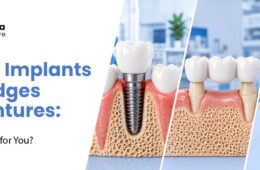
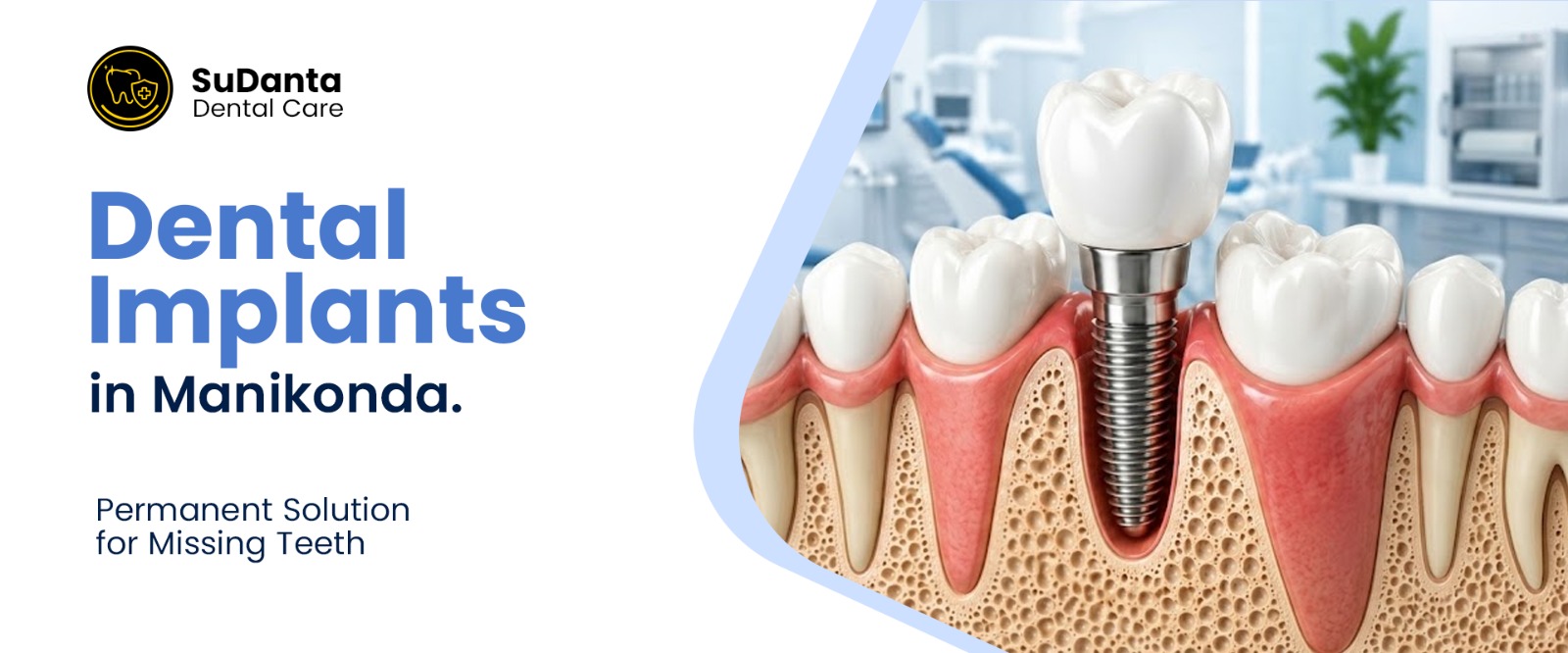
A dental implant is a small, screw-shaped titanium post that a trained dental surgeon places directly into your jawbone — in the empty socket where your tooth root used to sit.
Titanium is chosen because of a biological phenomenon called osseointegration. Bone cells actively grow onto and around titanium surfaces, fusing the implant to the jaw as securely as a natural root. This usually takes 3–6 months.
Once the implant is fully integrated into the bone, a small connecting piece called an abutment is attached to the top of it. A custom-made ceramic or zirconia crown — matched precisely to the colour and shape of your surrounding teeth — is then fixed onto the abutment.
The final result is a complete artificial tooth in three connected parts:
- Implant post — the titanium screw in the bone, acting as the root
- Abutment — the connector between the implant and the visible crown
- Crown — the tooth-coloured ceramic cap you see and use for chewing
Because the implant integrates with the bone, it stimulates the jawbone the same way a natural tooth root does. This prevents the bone shrinkage that happens when a tooth is missing — one of the most important advantages of implants over every other tooth replacement option.
Who Is a Good Candidate for Dental Implants?
Most adults who are missing one or more teeth are suitable for dental implants. However, your dentist needs to evaluate several factors before confirming candidacy:
You are a strong candidate if: – Your jawbone has sufficient volume and density to support the implant post – Your gums are healthy — no active gum disease – You are in generally good health and your diabetes (if any) is well controlled – You do not smoke heavily, or are willing to stop smoking around the time of surgery – Your mouth has adequate space for the implant without impinging on adjacent teeth
Factors that need to be addressed first: – Active gum disease — must be fully treated before implant placement. Bacteria in infected gum tissue can infect the implant. – Bone loss — if you have been missing the tooth for years, the jawbone in that area has likely shrunk. A bone graft can rebuild this volume before the implant is placed. – Uncontrolled diabetes — affects healing and significantly increases implant failure risk. Blood sugar must be well controlled (HbA1c below 7.5% ideally) before proceeding. – Certain medications — bisphosphonates (used for osteoporosis) can interfere with bone healing around implants. Your dentist and physician need to coordinate management.
A 3D CBCT scan gives your implant surgeon a precise three-dimensional map of your bone density, the exact location of nerves and sinus cavities, and the precise position for implant placement before surgery begins. This is now standard practice at quality clinics.
Types of Dental Implants Available in Manikonda (2026)
Single Tooth Implant
Replaces one missing tooth. One implant post supports one crown. The most common implant procedure. Involves no grinding or cutting of adjacent healthy teeth — unlike a bridge.
Implant-Supported Bridge
When two or three adjacent teeth are missing, two implants can support a bridge spanning the gap. More stable than traditional tooth-supported bridges and preserves the jawbone.
All-on-4 Dental Implants
A revolutionary technique that supports a complete fixed arch of teeth (all upper or all lower teeth) on just four strategically placed implants. Two implants go straight into the bone at the front; two are angled at the back to engage denser bone and avoid the sinus cavity. Ideal for patients who have lost most or all teeth in one arch and want a permanent, non-removable solution.
All-on-6 Dental Implants
The same concept as All-on-4, but with 6 implant posts for even greater load distribution and stability. Recommended when bone density and volume allow — the result is more durable and can support a wider variety of crown materials.
Mini Implants
Narrower diameter implants (less than 3mm) used when bone volume is limited or to stabilise existing removable dentures. Less invasive to place but not suitable for all situations. Your dentist will determine whether mini implants are appropriate.
Zygomatic Implants
For patients with severe bone loss in the upper jaw where standard implants cannot be placed, zygomatic implants anchor into the cheekbone (zygoma) instead. This is a specialist procedure for complex cases.
Dental Implant Cost in Manikonda and Hyderabad (2026)
The overall investment for dental implants depends on several factors unique to your case. No two patients are the same — the number of teeth being replaced, the implant brand selected, whether additional procedures like bone grafting or sinus lifting are needed, and the complexity of your anatomy all play a role.
Important: Always ask for an all-inclusive written quote before committing to treatment. The implant post, abutment, crown, CBCT scan fee, and any bone grafting required should all be clearly itemised. Some clinics quote only the implant post, making the final bill a surprise. At Sudanta Dental Care, your complete treatment plan and estimate are provided in writing before anything begins. Book a free consultation to get your personalised assessment.
Korean vs. Swiss Implant Brands — What Is the Real Difference?
Patients often encounter the choice between Korean implant brands (Osstem, Dentium, Megagen) and Swiss or European brands (Nobel Biocare, Straumann, Zimmer Biomet). The price difference is significant. Here is an honest comparison:
| Criteria | Korean Brands (Osstem, Dentium) | Swiss/European Brands (Nobel, Straumann) |
| Relative cost | More affordable | Premium investment |
| Years of published clinical data | 15–20 years | 30–40 years |
| 10-year success rate | 95%+ | 97%+ |
| Best for | Standard cases, most patients | Complex cases, aesthetic front teeth, patients with special requirements |
| Availability of parts | Excellent in India | Excellent in India |
Research shows Korean implant brands have 15+ years of strong clinical data with success rates comparable to European brands for the vast majority of standard cases. The 2% difference in long-term success rate often matters more in specific clinical scenarios — complex bone situations, aesthetic zones, or patients who have had previous implant failures — than in straightforward single-tooth replacements.
For most patients at Sudanta Dental Care in Manikonda, Korean implants offer exceptional value. Your implant surgeon will recommend the right brand for your specific case.
The Dental Implant Procedure: Full Step-by-Step
Stage 1: Consultation and 3D CBCT Scan
The surgeon takes a cone beam CT scan — a three-dimensional X-ray that shows exact bone dimensions, the location of the inferior alveolar nerve (for lower implants), the sinus cavity (for upper implants), and the density of available bone. This scan is what separates modern implant placement from older guesswork methods.
Based on the scan, the surgeon creates a digital implant plan showing exactly where each implant will go, at what angle, and to what depth — before touching the patient.
Stage 2: Tooth Extraction (If Required)
If the tooth is still present and non-restorable, it is extracted. In some straightforward cases, an implant can be placed immediately at the same appointment — called immediate implant placement. This is assessed case by case.
Stage 3: Bone Grafting (If Required)
If the available bone is insufficient in volume or density, a bone graft is placed. This can involve your own bone, processed donor bone, synthetic bone substitute, or a combination. The graft heals and matures over 3–6 months before implant placement proceeds.
Stage 4: Implant Placement Surgery
Under local anaesthesia (and sedation if preferred), the surgeon makes a small incision in the gum and creates a precise channel in the bone using a specific sequence of drills — each slightly larger than the last. The titanium implant is then screwed into position with precise torque. The gum is closed with sutures.
At this stage, in some cases, a temporary crown can be placed on the implant immediately (immediate loading). In other cases, the implant is left to heal beneath the gum for 3–6 months.
Stage 5: Osseointegration (Healing Period: 3–6 Months)
Bone cells gradually grow onto the titanium surface over the next 3–6 months. This process — osseointegration — is what gives the implant its exceptional stability. A temporary removable prosthesis is worn during this period.
Stage 6: Abutment Placement
Once the surgeon confirms osseointegration is complete (usually via X-ray or torque testing), a small connecting piece (abutment) is attached to the top of the implant. The gum heals around this abutment over 2–4 weeks, forming a healthy collar of gum tissue around the future crown.
Stage 7: Crown Fabrication and Placement
An impression or digital scan of your mouth is taken and sent to a dental laboratory. The lab fabricates a custom ceramic or zirconia crown precisely matched to the size, shape, and colour of your surrounding natural teeth. The crown is then cemented or screwed onto the abutment.
From this point, you have a fully functioning, natural-looking permanent tooth.
Dental Implants vs. Dental Bridge vs. Removable Denture
| Comparison Factor | Dental Implant | Dental Bridge | Removable Denture |
| Feels like a natural tooth | Yes — completely | Partially | No — noticeable |
| Preserves jawbone | Yes | No | No |
| Adjacent teeth affected | None | Yes — both adjacent teeth ground down | None |
| Removal required | Never | Never | Daily removal for cleaning |
| Lifespan | 20–30 years or lifetime | 10–15 years | 5–8 years |
| Upfront cost | Highest | Moderate | Lowest |
| Long-term total cost | Best value | Moderate | Highest (repeated replacement) |
| Chewing efficiency | 100% (same as natural) | 80–90% | 60–70% |
| Speech effect | None | None | Can affect initially |
| Daily care | Brush and floss normally | Special floss threader needed | Removal and soaking required |
The most critical advantage implants have over all other options is bone preservation. When a tooth is missing, the bone in the empty socket receives no stimulation and gradually resorbs — shrinking in volume. This bone loss is visible as facial sagging over time in long-term denture wearers. Only a dental implant — anchored in the bone — delivers the mechanical stimulation that signals the bone to maintain its volume.
Success Rates and Longevity of Dental Implants
The global 10-year success rate for dental implants is consistently above 95%. Many implants placed in the 1980s are still functioning today — 40+ years later. With good oral hygiene and regular dental check-ups, most patients keep their implants for life.
Factors that increase the risk of implant failure: – Heavy smoking (reduces blood flow to healing tissue, impairs osseointegration) – Uncontrolled diabetes (impairs immune response and healing) – Poor oral hygiene (allows bacteria to infect the tissue around the implant) – Parafunctional habits like severe tooth grinding (excessive forces on the implant) – Choosing a clinic without proper sterile protocols or experienced implantologists
Pros and Cons of Dental Implants
| Pros | Cons |
| Most natural-looking and feeling tooth replacement | Higher upfront cost than bridges or dentures |
| Permanent — lasts 20–30 years or a lifetime | Requires surgery and a healing period of 3–6 months |
| Preserves jawbone — prevents facial sagging | Requires adequate bone volume (bone graft may add cost and time) |
| No impact on adjacent healthy teeth | Not covered by most standard dental insurance in India |
| No dietary restrictions — eat everything normally | Requires good long-term oral hygiene commitment |
| Easiest to clean — brush and floss normally | Immediate result not always possible (healing time needed) |
| Boosts confidence significantly |
The Future of Dental Implants (2026–2030)
Implant dentistry is evolving rapidly. Over the next four years, expect:
Same-day implants as standard: In straightforward cases, placing a functioning crown the same day as implant surgery will become the default, not the exception.
AI-guided implant planning: Software analyses your CBCT scan, identifies optimal implant positions accounting for bone density and nerve avoidance, and generates a surgical guide — a 3D-printed template that fits over your teeth and guides the drill to the exact pre-planned position.
Zirconia implants gaining ground: Ceramic (zirconia) alternatives to titanium implants are becoming more reliable. For patients with metal sensitivities or who prefer a non-metallic solution throughout, zirconia implants are a growing option.
Shorter healing times: New implant surface technologies — particularly hydrophilic (water-loving) surface treatments — accelerate osseointegration, potentially reducing the healing period to 6–8 weeks in optimal cases.
Digital workflows: From CBCT scan to digital impression to lab-fabricated crown — the entire workflow will be digital by 2028, reducing laboratory turnaround time and improving crown accuracy.
Book a Free Implant Consultation in Manikonda
The single biggest mistake with dental implants is waiting. Every month a tooth remains missing, the surrounding bone shrinks. What might have been a straightforward implant placement becomes one that needs bone grafting — adding cost, complexity, and 3–6 extra months.
Sudanta Dental Care in Manikonda offers free initial consultations for dental implants. The team will assess your case, take the necessary scans, and give you a complete, transparent treatment plan and cost estimate before you make any commitment.
Frequently Asked Questions
Q: How long do dental implants last?
A: With good oral hygiene and regular 6-monthly check-ups, dental implants typically last 20–30 years and in many cases a lifetime. The implant post itself rarely fails — it is the crown on top that may need replacement after 15–20 years.
Q: Is dental implant surgery painful?
A: The surgery is performed under local anaesthesia. You feel pressure and movement but not pain during the procedure. Post-operative soreness for 3–5 days is normal and managed effectively with standard pain relief.
Q: Can I get a dental implant if the tooth has been missing for years?
A: Yes, but bone loss is likely during that time. A 3D CBCT scan will show exactly how much bone remains. A bone graft is often needed first and adds 3–6 months to the treatment timeline. The earlier you act, the simpler and less expensive the procedure.
Q: Can I get dental implants if I have diabetes?
A: Controlled diabetes (HbA1c below 7.5–8%) is not a contraindication. Uncontrolled diabetes significantly increases infection risk and implant failure. Your dentist and physician will coordinate to ensure your blood sugar is well managed before proceeding.
Q: Will my dental implant look natural?
A: Yes. The crown placed on the implant is custom-fabricated from ceramic or zirconia to match the exact shape, size, and colour of your surrounding natural teeth. Colleagues and friends will not be able to tell the difference.
Q: How do I clean a dental implant?
A: Exactly like a natural tooth. Brush twice daily with a soft-bristle toothbrush. Floss daily. Use an interdental brush or water flosser for the area between the implant crown and adjacent teeth. No special cleaning solutions are needed.