Root canal treatment. Those three words make most people grip the armrests of the dental chair even before the dentist picks up an instrument. The fear is universal — and almost entirely misplaced.
Here is what dentists across Hyderabad wish more patients understood: root canal treatment does not cause pain. It ends pain. The severe, throbbing toothache that sends you to the clinic in the first place — that comes from the infected tooth, not the treatment. The root canal removes the source of that pain.
In 2026, root canal treatment in Manikonda is faster, more comfortable, and more predictable than at any point in the history of dentistry. Single-sitting root canals are now routine. Rotary instruments replace older, slower hand files. Computer-controlled anaesthesia eliminates the sting of the injection itself. Most patients walk out feeling better than they felt when they walked in.
This complete guide covers everything — what the procedure involves, when you need one, and how to make your experience completely comfortable from start to finish.
What Is Root Canal Treatment? (Simple Explanation)
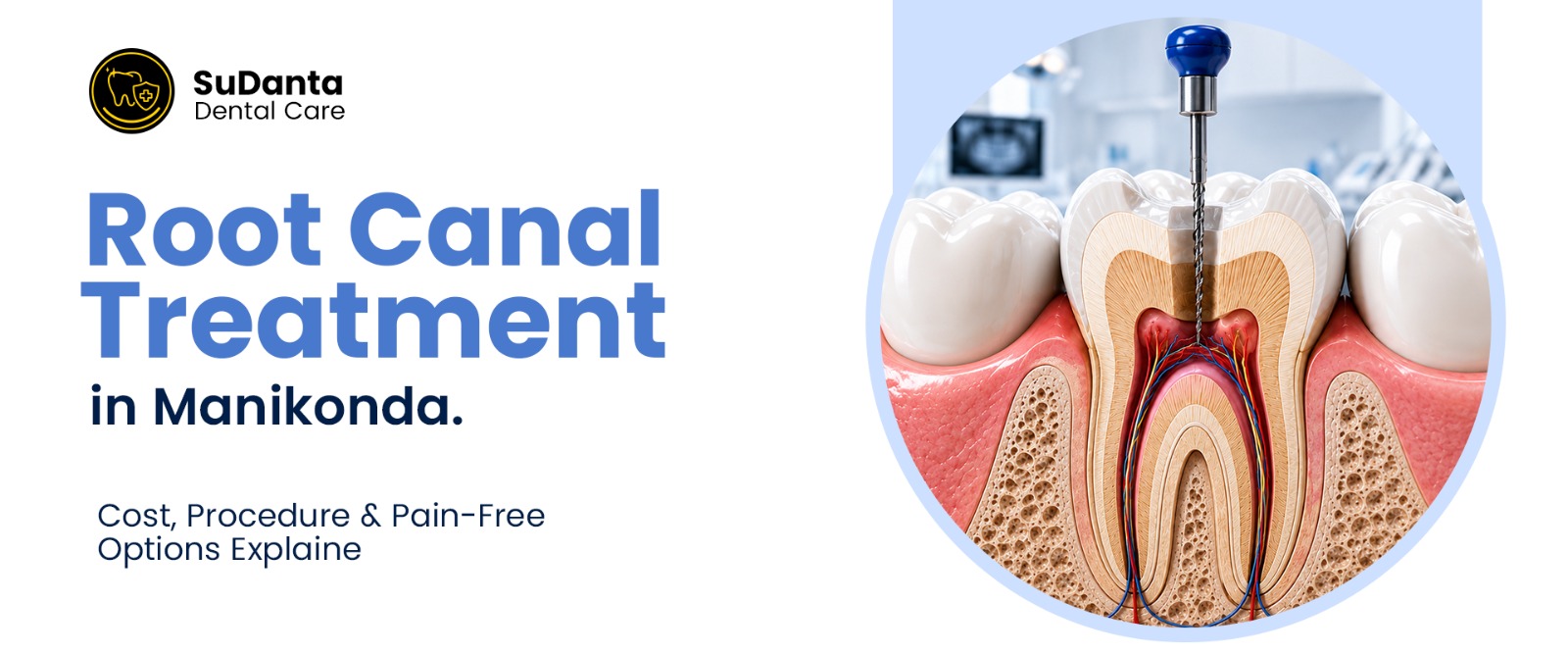
Your tooth has three distinct layers:
- Enamel — the hard, white outer shell you see. The hardest substance in the human body.
- Dentin — the yellowish layer beneath enamel. Sensitive and softer.
- Pulp — the innermost soft tissue that runs through the centre of the tooth and down through the roots. Contains nerves, blood vessels, and connective tissue.
When you are a child, the pulp is important — it nourishes the developing tooth. Once the tooth is fully grown, it can survive without its pulp because it receives nutrients from surrounding tissues.
When bacteria enter the pulp — usually through a deep cavity, a crack, or a chip — they infect this tissue. The infection creates pressure inside the tooth (there is nowhere for that pressure to go), which causes the characteristic throbbing pain. The infection also spreads down through the roots and begins attacking the surrounding jawbone.
Root canal treatment removes all of this infected pulp tissue, cleans and shapes the hollow canal spaces left behind, disinfects everything thoroughly, and seals the tooth permanently. The tooth remains in your mouth, functional and intact — just without its nerve, which it no longer needs.
When Does a Tooth Need a Root Canal?
Your dentist will recommend root canal treatment when:
- A cavity has progressed so deeply that it has reached or infected the pulp
- You experience severe, spontaneous toothache — especially throbbing pain at night
- Sensitivity to hot or cold lingers for more than 20 seconds after the source is removed
- You see a swelling, gum boil, or pimple-like bump on the gum near the tooth
- The tooth has darkened or changed colour (grey, black, or dark yellow compared to neighbouring teeth)
- An X-ray reveals a dark shadow at the root tip — this indicates bone loss from a spreading abscess (periapical abscess)
- The tooth is cracked or fractured in a way that exposes the pulp
One important clarification: not all toothaches require root canal treatment. Sometimes a filling is enough. Your dentist determines what is needed after examining the tooth clinically and reviewing an X-ray. Do not assume — and do not let fear of the procedure cause you to skip the examination.
Root Canal Treatment: Complete Step-by-Step Procedure
Understanding what happens during a root canal removes much of the anxiety. Here is every step, in plain language:
Step 1: Diagnosis and Digital X-Ray (10–15 minutes)
The dentist examines your tooth — testing sensitivity, checking for swelling, looking at gum health — and takes a digital X-ray. The X-ray shows how deep the decay goes, how many roots the tooth has, how many canals each root contains, and whether there is any bone involvement around the root tips.
This step is essential. A molar can have 3, 4, or in some cases 5 root canals. Missing even one leads to treatment failure later.
Step 2: Local Anaesthesia (2–5 minutes)
A local anaesthetic is injected near the tooth and the nerve that supplies it. In 2026, most clinics use topical numbing gel on the gum before the injection — so you barely feel the needle. Computer-controlled injection devices deliver the anaesthetic slowly and evenly, preventing the burning sensation older syringes caused.
Once numb — which takes about 3–5 minutes to fully set in — you will feel zero pain for the entire procedure. You may feel pressure, vibration, and movement. Not pain.
Step 3: Rubber Dam Isolation
The dentist places a thin rubber sheet (rubber dam) around the tooth, secured with a small clamp. This keeps the tooth completely dry and free from saliva during treatment. It also prevents you from accidentally swallowing any small instruments or irrigating solutions.
Step 4: Access Opening
Using a dental drill, the dentist creates a small opening through the crown of the tooth to reach the pulp chamber beneath. This is the only part where the drill is used.
Step 5: Pulp Removal and Canal Shaping
Using small, flexible instruments called files — in modern clinics, these are nickel-titanium rotary files driven by an electric motor — the dentist removes all infected pulp tissue and shapes the canal spaces. The files are used in a specific sequence, gradually enlarging and cleaning the canals while precisely following their natural curved anatomy.
Electronic apex locators measure the exact length of each canal to within 0.1mm — ensuring the dentist cleans to the very tip of the root without going beyond it.
Step 6: Irrigation and Disinfection
Between each file, the canals are flushed with irrigating solutions — most commonly sodium hypochlorite (a mild bleach solution). This dissolves remaining organic tissue and kills bacteria. Ultrasonic activation of the irrigant in 2026-era clinics makes this disinfection dramatically more thorough than older methods.
Step 7: Canal Sealing
The cleaned, shaped canals are dried and filled with gutta-percha — a rubber-like material that is biocompatible and thermally stable. It is compacted into the canals and sealed at the opening with root canal cement, creating an airtight, bacteria-proof seal.
Step 8: Temporary or Permanent Restoration
The opening in the tooth is sealed with a temporary filling (if a second visit is needed) or a permanent composite filling (if the work is completed in one sitting).
Step 9: Crown Placement (Separate Appointment)
A root canal-treated tooth becomes more brittle because it no longer receives moisture from a living pulp. For back teeth — premolars and molars — a dental crown is almost always placed over the treated tooth to protect it from fracturing under chewing forces. The crown appointment typically happens 1–3 weeks after the root canal.
Single-Sitting Root Canal vs. Multi-Sitting Root Canal
This is one of the most common questions patients ask. The answer depends on the clinical situation:
| Single-Sitting Root Canal | Multi-Sitting Root Canal | |
| Number of visits | 1 (60–90 minutes) | 2–3 visits |
| Best for | Straightforward cases with no active abscess | Complex cases: severe abscess, curved canals, retreatment, heavily calcified canals |
| Medication placed between visits? | Not needed | Calcium hydroxide placed to continue disinfecting |
| Patient experience | Faster, fewer visits | More manageable for anxious patients |
| Outcome | Equally successful as multi-sitting when done correctly | Often better for genuinely complex cases |
The trend in 2026 is strongly toward single-sitting root canals for most cases. Advanced rotary systems and better irrigants make thorough canal cleaning much faster and more predictable than 10 years ago.
At Sudanta Dental Care in Manikonda, the dentist will review your X-ray and honestly tell you whether your tooth is a single-sitting candidate.
What Affects the Complexity of a Root Canal?
Not all root canals are equally straightforward. Several clinical factors determine how complex your specific case will be:
Number of root canals: Front teeth typically have one canal. Premolars have one or two. Molars have three, four, or sometimes five canals. More canals mean more work, more time, and a more skilled technique.
Degree of infection: A tooth with a large periapical abscess (bone infection around the root tip) requires more thorough disinfection and may need a multi-sitting approach with a medicated dressing placed between visits.
Canal curvature: Some root canals are straight and easy to clean. Others curve sharply — a single tooth can have canals that curve in different directions. Severely curved canals require specialised file systems and experienced hands.
Calcification: In older patients, or after a tooth has experienced trauma, the canals can narrow significantly due to deposits of calcium inside the canal walls. These calcified canals are harder to locate and clean — sometimes requiring magnification under a dental microscope.
Retreatment cases: If a previous root canal has failed — due to a missed canal, a cracked root, or a new infection — retreatment is significantly more complex than a first-time root canal.
Understanding these factors explains why your dentist examines your X-ray carefully before starting — and why the same procedure can feel very different from one tooth to the next.
Is Root Canal Treatment Painful? Honest Answer.
The honest answer is: under proper local anaesthesia — no, it is not painful. The procedure creates pressure sensations and sometimes a mild ache when working near the root tip, but sharp, electric pain should not occur. If it does, a good dentist stops and adds more anaesthetic.
Post-procedure experience: – First 6–12 hours: The area feels tender and a bit sore as the anaesthetic wears off. This is normal. – Days 1–3: Mild soreness when biting on the treated tooth. Manageable with over-the-counter ibuprofen or paracetamol. – After 3 days: Most patients feel no discomfort at all. The tooth that was throbbing before the procedure is now quiet.
The pain people fear is almost always the pain they were already experiencing from the infection — not the treatment itself. The root canal ends that cycle.
Pain-Free Root Canal Options at Sudanta Dental Care, Manikonda
Sudanta Dental Care specifically designs its root canal protocol around patient comfort:
Topical anaesthetic application: Before any injection, a numbing gel is applied to the gum for 2–3 minutes. By the time the needle approaches, you barely feel it.
Slow-release anaesthetic technique: The anaesthetic is delivered slowly and at body temperature, preventing the burning sensation that older, faster injections caused.
Rotary endodontics (NiTi files): Nickel-titanium rotary files move continuously and smoothly — they do not require the clicking, cranking motion of old hand files. Patients report this as a significant comfort improvement.
Electronic apex locator: Precisely measures canal length so the dentist never accidentally works beyond the root tip — which is where pain can occur.
Distraction techniques for anxious patients: A full briefing before the procedure, continuous communication throughout, and the option to raise your hand anytime to pause.
Root Canal vs. Tooth Extraction: Which Should You Choose?
Many patients ask this genuinely: “Why not just pull the tooth? Is a root canal really worth it?”
Here is the complete comparison:
| Factor | Root Canal + Crown | Tooth Extraction + Implant |
| Preserves natural tooth? | Yes | No |
| Recovery time | 3–5 days | 3–6 months (implant healing) |
| Adjacent teeth affected? | No | May shift into the gap |
| Jawbone preserved? | Yes | Bone starts shrinking at extraction site |
| Chewing restored? | Immediately after crown | After full implant healing |
| Long-term outcome | Excellent with good crown | Excellent but longer, more complex process |
| Best choice in most cases? | YES | When root canal is not possible |
Dental research consistently shows that preserving the natural tooth is the top priority in dentistry. A root canal followed by a good crown can last a lifetime. Tooth extraction followed by an implant achieves a comparable final result but through a significantly more complex and longer treatment journey.
Choose extraction only when the tooth is non-restorable — fractured below the gum line, with excessive bone loss, or when the root structure cannot support a crown.
What To Do After Root Canal Treatment (Post-Operative Care)
Proper aftercare directly affects your recovery speed and long-term success:
Immediately after (first 24 hours): – Avoid eating until the anaesthesia fully wears off — usually 2–3 hours – Eat soft foods: rice, daal, yoghurt, idli, banana – Avoid chewing on the treated side until the crown is placed – Take prescribed antibiotics for the full course (usually 5 days) – Use prescribed or over-the-counter pain relief for the first 2–3 days
Ongoing care: – Get your crown placed within the timeframe your dentist recommends — usually 1–3 weeks – Brush and floss normally around the treated tooth – Schedule a 6-month review to confirm the root canal is healing properly on X-ray
Pros and Cons of Root Canal Treatment
| Pros | Cons |
| Ends the toothache permanently | Requires 1–3 appointments |
| Saves the natural tooth | The tooth needs a crown afterward |
| Prevents infection from spreading to adjacent teeth and jawbone | Mild soreness for 2–3 days after |
| Far better long-term outcome than extraction in most cases | In rare cases (complex anatomy), retreatment needed |
| No dietary restrictions once the crown is placed | Treated tooth is more brittle — crown is critical |
| Proven long-term success rate — 85–90% at 10 years |
The Future of Root Canal Treatment (2026–2030)
The next four years will bring meaningful improvements to root canal treatment:
AI-assisted treatment planning: Artificial intelligence analyses CBCT scans and predicts canal anatomy, helping dentists identify hidden canals before they begin. This dramatically reduces the risk of a missed canal — the most common cause of treatment failure.
Bioceramic sealers: New generation sealing materials that are more biocompatible, expand slightly on setting, and create a superior bacterial seal compared to zinc oxide eugenol cements used in the past.
Regenerative endodontics: For young patients with incompletely formed roots, regenerative techniques can encourage the body to grow new pulp-like tissue — a genuine biological repair rather than just sealing the canal.
Guided endodontic access: Using 3D-printed surgical guides (similar to guided implant surgery), dentists can drill the access opening with sub-millimetre precision — reducing unnecessary removal of healthy tooth structure.
Photodynamic disinfection: Light-activated antimicrobial agents that penetrate dentinal tubules more deeply than chemical irrigants — killing bacteria in places that conventional solutions cannot reach.
Book a Pain-Free Root Canal in Manikonda
If you have been putting off a dental visit because you are afraid of root canal treatment — this is the year to act. Modern root canal therapy at Sudanta Dental Care in Manikonda is a far more comfortable experience than anything you may have heard from older generations.
The team will examine your tooth, explain exactly what it needs, show you the X-ray, and answer every question you have — before any treatment begins. There are no surprises.
Frequently Asked Questions
Q: How long does a root canal procedure take?
A: A single-sitting root canal typically takes 60–90 minutes. A molar with 4 canals in a straightforward case takes around 90 minutes. Complex cases or retreatments may need 2–3 shorter visits.
Q: Can I eat normally after root canal treatment?
A: Wait until the anaesthetic wears off (2–3 hours). Eat soft foods on the first day. Avoid chewing on the treated side until your crown is placed.
Q: How long does a root canal last?
A: A properly performed root canal, followed by a good quality crown, can last a lifetime. Studies show 85–90% of root canals are still functioning at 10 years.
Q: Is a crown always necessary after a root canal?
A: For back teeth (premolars and molars) — yes, a crown is strongly recommended. These teeth bear the highest chewing forces, and the treated tooth is more brittle. Front teeth can sometimes be restored with a post-and-core and composite buildup without a full crown, but your dentist will advise case by case.
Q: My dentist said I need a root canal but I feel no pain. Why?
A: Some infected teeth cause no pain because the nerve has died — the infection is present, visible on X-ray, but no longer causing sensory pain. This is more common than people realise. An X-ray finding of a periapical abscess or bone loss always warrants treatment, even without symptoms.
Q: Can root canal treatment fail?
A: Root canal treatment fails in approximately 10–15% of cases over 10 years. The most common causes are a missed canal, a crack in the tooth, or a crown that does not seal properly. Retreatment (a second root canal) can often rescue a failing tooth. This is why choosing an experienced specialist matters.
Q: How soon should I get the crown after a root canal?
A: Within 1–3 weeks, as your dentist advises. Delaying the crown leaves the treated tooth vulnerable to fracture and reinfection through the temporary filling.